Thanks to 'the Old Parson' for posting this blog. It's bad enough when members of the synod try to accommodate the Divine Service to reformed sensibilities, but to have the chair of the missions department at one of the Concordia's suggest that we should accommodate it to Muslim sensibilities is unthinkable.
The professor in question is Herb Hoefer, chair of Missions at Concordia, Portland. He begins with apparent giddiness that a group of Muslim academics visiting the chapel service approved of the fact that the hymns, assuming they sang hymns, did not mention the name of Jesus, saying, "They discussed that they could have worshipped with the same words that they heard, for it so happened that the songs they heard only referred to God and not to Jesus." What a shame that a chair of missions welcomes their approval. Sadly, it doesn't end there; he goes on to wonder what else could be changed for the sake of mission in the "the Muslim context."
Perhaps, making Jesus the, "object of our worship," is a mistake. He says, "We have strong biblical authority for using the most common term 'Lord' when addressing the Resurrected One. That term would not feed Muslim misconceptions, as the term :Jesus' does." Well, there goes the ancient Church's earliest confession that, "Jesus is Lord."
He proposes changing the wording of the creeds to avoid Muslim misconceptions about Christians worshiping more than one God. He proposes that the third article of the Creeds be changed to avoid the offensive words, "Christian," or, "catholic." Instead he advocates using the word "umma," a Muslim term that suggests a fellowship of believers.
He also asserts that we remove the epistles from the Divine Service, or any worship service, since the epistles are largely Pauline and Muslims think that Paul was a false teacher who altered the Christian message from its previous pristine purity. This was a purity that conformed to the teaching of Muhammad. Of course, if you take out the Pauline epistles you don't hear unhelpful things like, "I am not ashamed of the gospel," and, "The Word of the cross is to those who are perishing foolishness."
The gist of the Professor's proposals is that we should alter Christianity itself, at least in the Muslim mission context, and seems to want to allow the Muslims to interpret our faith according to their own. Take out anything that is offensive in the Christian faith and what do you have...nothing, or maybe in that context, Islam.
Here are some other gems from the professor:
"Whenever we use the term 'Son of God,' Muslims immediately think blasphemy. We need to explain to Muslims that the term is a biblical metaphor that is used of individuals and even of Israel. It is not a biological description but a theological affirmation using a human metaphor. The Second Person of the Trinity is a 'chip off the old block.'"
"We need to make that explanation, but public worship typically is not the proper venue for that discussion. It would be best simply to avoid the term (Son of God) in our preaching and guide our people also to avoid it in their witnessing."
"In all of these matters, the process of discussing the reasons for the changes would become a great opportunity for educating and training our Christians as well as they try to witness effectively to their Muslim neighbors."
Of course, orthodox Christians would say that were we to adopt these proposals we would not be witnessing at all but compromising the truth of the gospel. The Apostles words are appropriate here, "even if we or an angel from heaven should preach a gospel other than the one we have preached to you, let him be accursed."
In an earlier blog, I took Tiny Muskins, a Danish Roman bishop, to task for suggesting that Christians adopt the name "Allah" as a title for God in order to accommodate Muslim sensitivities. These suggestions by one of our own are just as bad.
Rather than altering the historical Christian witness and removing traditional language from the Divine Service in order to be "effective," perhaps Concordia should alter the status of the professor and remove him from his position at one of our colleges.
Monday, May 12, 2008
Missions Gone Wild
Friday, May 09, 2008
Sacramental Docetism

Docetism is a term that comes to us from the Greek word "doketo." Doketo means "to think" or "to seem." An early heretical group, the gnostics, claimed that Christ did not truly appear in the flesh, but merely "seemed" to possess a body. Thus, the gnostics taught docetism. This was a denial of the true flesh of Christ and a heretical challenge to the fundamental doctrines of the incarnation and the substitutionary atonement. If Christ merely appeared to be human or have a body, He did not pay for the sins of the world on the cross. In fact, He did not become human and has in no way shared in our humanity. The apostle John addresses this error in his first epistle to the church, saying, "every spirit that confesses that Jesus Christ has come in the flesh is from God, and every spirit that does not confess Jesus is not from God." 1 John 4:2
But the reformed denial of the true, bodily presence of Christ in the supper is a sort of sacramental docetism. That is, they deny the very words of Christ in the institution of the Supper as being in any sense real. Classically, the reformed have done this on the same basis as the underlying philosophical position of the gnostics. That is, they deny any real connection between the human and divine natures of Christ. The communication between the divine and human natures has always been a problem for the reformed. That denial has real consequences in their view of the nature of the Lord's Supper. They deny that Christ's body is actually or really present, distributed and received in the Sacrament at the Altar. They are in effect Sacramental Docetists.
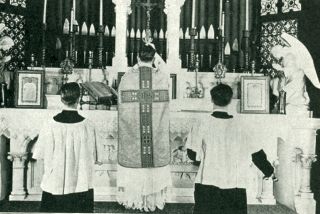
Lutherans boldly confess the true, bodily presence of Christ in the Holy Supper. We confess it in word and deed. How can we confess the true, bodily presence of Christ by our deeds? Christians have historically done this by reverencing the elements at the consecration. First, it should be clear which elements we reverence. We do not, as some say, reverence the bread and wine. That would be idolatry. We reverence the heavenly elements of Christ's true, physical body and blood which are, "in, with, and under," the earthly elements. We do so by bowing deeply or genuflecting at the consecration and elevation. With these bodily actions we are making a bold confession of the true, bodily presence of Christ in the Sacrament. Christ has come physically and really into our presence in the consecration. How can we do other than humbly and reverently acknowledge that presence?
This may seem foreign at first, maybe a "little catholic." Of course, it is. It's what catholics, Lutheran, Roman, and Greek, have done for centuries. It is also a confession against the Sacramental Docetism of American Evangelicalism.
Tuesday, April 15, 2008
On Making the Sign of the Cross

Most rites of baptism include signing the cross over the one to be baptized. "Receive the sign of the holy cross both on your forehead + and upon your heart+ to mark you as you as one redeemed by Christ the crucified." In baptism we are united to Christ in His life, death, and resurrection. This baptism comforts us throughout our lives, assuring us that all the benefits of the death and resurrection of Christ have been delivered to us personally.
It is appropriate, then, that Christians through the ages have made the sign of the cross to remember that they have been redeemed by Christ the crucified. As early as the third century, Tertullian wrote that Christians make the sign of the cross, "in all our travels and movements. " Chrysostom in the fifth century said that making the sign of the cross reminds us of the price that has been paid to remove sin. In the Small Catechism, Luther prescribed making the sign of the cross at the opening and closing of the day.
In the Divine service we also make the sign of the cross. We do it at the invocation to remind us that God has called us together as His baptized people. At the absolution we make the sign of the cross, recognizing that absolution, along with the other sacraments, derives its power and authority from the salvation won on the cross. Also, absolution is a renewal of our baptism. At the last line of the creeds the cross is made because the creeds are a summary of the gospel that the Christian Church proclaims. The Nicene Creed was an expansion of the baptismal creed in Jerusalem, just as the Apostle's Creed is used in the in the west for baptism. In some churches the practice of making the sign of the cross at the last petition of the Lord's prayer is observed. God has truly delivered us from evil by the cross. It is appropriate to make the sign of the cross during the consecration, when you receive the elements, and at the dismissal from the table. At the benediction the sign of the cross is made. Just as God called us together as His baptized people, He sends us back out into the world as His baptized people.
At the seminary, the baptismal font stood at the entrance of the nave. As we passed the font, many of the seminarians would put our fingers into the font and sign ourselves upon entering and leaving the services. For some time now, our church has had a font near the entrance of the nave to give people the opportunity to remember their baptism in that way.
The sign of the cross is made either with two or three fingers. Two fingers represent the two natures of Christ. Three fingers represent the Holy Trinity. It begins at the forehead and goes down to the breastbone; it rises to the right shoulder and over to the left shoulder. Some go from the breastbone to the left shoulder and over to the right. The number of fingers or precise directions are not important.
Making the sign of the cross, of course, is neither commanded nor forbidden by Scripture. It is simply and ancient and commendable practice of the Christian Church. The gestures and postures of Christian worship exist simply to instruct us and remind us to offer service to God with reverence and awe. I commend this practice to you as God's baptized children.
Thursday, April 10, 2008
Reverence and Awe
![]()
With the advent of contemporary worship, there has come a radical paradigm shift in the way that Christians approach God. The friendship of God is so emphasized that the worshiper forgets the glory and majesty of God. Yes, Hebrews invites us to approach God with boldness and confidence, but does that mean we approach Him so casually without any reverence and awe?
A local church recently pulled its pews from the nave in order to accommodate tables and chairs. Now the worshipers can come with their lattes and relax while the band plays really rad music. I suspect the church lady might say something like, "Isn't that special? Where did you get the idea for that? Could it be....SATAN?"
In the past there were some good, solid customs established in the worship of the Church that helped inspire a sense of reverence and awe for the majesty of God. The pews had kneelers and the worshipers knelt to offer prayer and thanksgiving to God. Before entering the pew you would kneel toward the altar as a sign of reverence for God's gifts. At the name of Jesus people would bow their heads. Christians would bow slightly at the Gloria Patri. When it came to the "incarnatus est" clause of the creed, the parishioner would bow deeply as a sign of reverence for the doctrine of the incarnation. Christians would make the sign of the cross at the invocation, absolution, the end of the creed, at receiving the elements, and at the benediction. Another old custom, and one that is worthy of imitation, was to bow at the consecration of the elements. They recognized, as we should, that Christ is truly and physically present in, with, and under the elements because of the consecration.
Now, of course, this can all be done in a hypocritical fashion without any true reverence in the heart for our Savior, but these old customs also had the advantage of reminding people they were in the presence of God. God is to be treated with reverence and awe. Although we approach God with boldness and confidence, we do not approach Him in a casual way.
Think about how the worshipers in the Scriptures approached God. When Moses met God at the burning bush, he not only took off his shoes but fell on his face. When Isaiah was ushered into the presence of God, He cried out, "Woe is me; I am undone. For I have seen the Holy One of Israel." When the apostle John saw the image of Christ in a vision in the book of Revelation he fell on his face, John says, "as a dead man." Don't we believe that God Himself is truly present with us in worship anymore?
So leave your latte at home and remember that it is no small thing to be in the presence of a holy God. Come and worship with a sense of reverence and awe.
Sunday, February 10, 2008
Confessions of a Lent Lover
The Season of Lent begins with Ash Wednesday and continues 40 days, Sundays excluded, in preparation for Easter. Lent is a season of repentance and reflection, a time to turn from our sin and to look to Christ in faith. It is especially a time to remember the sufferings of Christ and His atoning work.
The gospel lessons during Lent highlight our Lord's struggle with the evil one. The first Sunday, Invocabit, reminds us of our Lord's struggle and victory over the temptations of Satan in the desert. On Reminscere Sunday Christ delivers the Canaanite woman's daughter from the demon. On Occuli Sunday Christ delivers a deaf-mute from demons and is accused by his human enemies of being the prince and ruler of the demons. Laetere Sunday is a respite with Christ feeding the five thousand, but on Judica Sunday the struggle intensifies with the enemies of Christ attempting to stone him. This struggle finds it culmination on Passion Sunday and Good Friday where Christ triumphs over sin, death, and hell on the cross.
Although Sundays are considered excluded from the 40 day count in Lent (Sundays are always celebrations of the resurrection), the mood of the Sundays in Lent is more subdued than most Sundays. The alleluias are absent, and there is no Gloria in excelsis. The gospel verse is changed in Lutheran Worship from "Alleluia, Lord to whom shall we go..." to "Return to the Lord Your God..." There are no flowers on the altar except on Laetere Sunday. During passiontide, beginning Judica Sunday, the crosses and crucifix are either removed or covered in purple.Lent is also a season of catechesis. In the ancient church catechumens were prepared during Lent for their baptism at Easter Vigil. The Lutheran Church has customarily used the Lenten season for sermons on the catechism. This year we are looking forward to baptizing several people at Easter Vigil and during the Lenten season.
I love Lent. I love the Wednesday soup suppers, the increased focus on repentance and confession, and the anticipation of the celebration of Easter. I love the hymns and the responses. I love the Dorian chant. I love it all. Blessings to everyone during this blessed season.
Monday, December 31, 2007
What if It had been Harry Potter?
The transit system in Ft. Worth Texas has a strict policy; there will be no loud or abusive behavior on their buses. The question is, what constitutes loud or abusive behavior. Is it loud or abusive when a woman reads to her children on the bus? Most sane people would answer no. What about when she reads something really subversive like the Bible?
Christine Lutz, a mother of four, was riding on the bus with her children on Saturday, sabbath for Seventh Day Adventists, and reading the Bible to them when the driver ordered her to stop reading. The bus driver insisted, "This is not the time or the place." Mrs. Lutz refused. A supervisor was then brought on board. When the mother refused to stop reading the Bible, The supervisor escorted her and her children off the bus.
Without knowing all the facts in the incident, it's hard to say for sure. Hypothetically, she could have been making a nuisance of herself. On the other hand, its hard to believe that the woman could have been creating a disturbance simply by reading the Bible to her children. Since when does a bus driver decide an appropriate time and place for a mother to be teaching her children the Bible? What if she had been reading Harry Potter or Grim's Fairy Tales? Can you picture the bus driver telling her that it's not an appropriate time or place to read these books to her children.
Religious conversation seems to make a good number of people uncomfortable. Religion and politics are the two things you don't bring up in polite conversation. But religious expression is a guaranteed right in the first amendment. In the end, it doesn't matter if this mother's conversation with her children was offensive to passengers or uncomfortable to them. The constitution does not guarantee the right to not be offended. Of course, I'm sure there are judges who could find that right in the constitution if they were so inclined.
Let's hope that this woman is able to sue the transit system in Ft. Worth and that it sends a signal to a culture that is becoming increasingly hostile to faith.
Wednesday, December 26, 2007
Are Christians Taking Christ out of Christmas?

I remember that as a kid I would sometimes hear people express disapproval over Christmas being shortened to Xmas. You would hear a lot of expressions of disgust that, "Christ was being taken out of Christmas." In fact, Merry Xmas is a legitimately Christian expression, at least in writing. X is the Greek symbol for Christ. So merry Xmas is Merry Christmas.
Today, Christians are rallying together to combat the 'War on Christmas.' We don't like it that people have stopped saying, "Merry Christmas," for the more politically correct, "happy holidays." Actually, "happy holidays," should be offensive to about 10% of the population who consider themselves atheists. Maybe it's not such a politically correct term after all.
But if Christians are going to fault the secular world for taking Christ out of Christmas, perhaps they should think about how they celebrate Christmas themselves. I wonder how many Christians who complain so loudly about the war on Christmas actually came to either a Christmas Eve or Christmas day service. Remember what your mother said, "When you point a finger at someone else, there are three more pointing back at you.
I realize that the reason so many Christians have forsaken the custom of going to Mass on Christmas is that pastors have not given them the option. Protestantism in particular has a long history of eschewing any Christmas celebrations. But most Christians today celebrate Christmas. The difference is that it is now a more secular holiday. Secular holiday, boy talk about your oxymorons!
One church in our town actually canceled services a couple of years ago when Christmas fell on a Sunday so that people could stay home and be with their families. Well, after all, that is what Christmas is about, isn't it.
Look, I don't believe Christians are required to attend religious services on Christmas. But please, if you are going to complain about people forgetting, "the reason for the season," don't be a hypocrite and forsake the traditional assembling of Christians on that day. After all, He truly is the reason for the season.